Making moisturizing body cream starts with understanding how different cosmetic ingredients work together to hydrate, soften, protect, and improve the appearance of the skin. A well-formulated body cream is more than a mixture of oils and water. It requires carefully selected humectants, emollients, occlusives, emulsifiers, preservatives, and skin-conditioning ingredients to create a stable and pleasant product.
The right formulation can make a significant difference when developing a moisturizer for everyday use, professional cosmetic production, private-label manufacturing, or personal skincare. Different skin types require different ingredient combinations, and a formula designed for dry skin may feel too rich for oily skin. Understanding these differences helps create products that are effective, comfortable, and commercially appealing.
Understanding the Basics of Body Cream Formulation
A body cream generally contains a combination of an aqueous phase and an oil phase. The water phase provides hydration, while oils and other lipid-based ingredients help soften the skin and reduce moisture loss. Because oil and water naturally separate, an emulsifier is normally required to create a smooth, uniform, and stable cream.
The formulation process also depends on the desired texture and application experience. A lightweight cream may contain higher levels of water and lighter emollients, while a rich body butter may contain more oils, fatty alcohols, and occlusive ingredients. The final balance determines whether the product feels silky, rich, lightweight, nourishing, or protective.
What Are the Main Ingredient Categories?
When developing a body cream, it is useful to think about ingredients according to their function rather than simply choosing popular raw materials. Each ingredient should have a specific purpose within the formulation. Some attract water, some soften the skin, some reduce water loss, and others help keep the entire formula stable during storage and use.
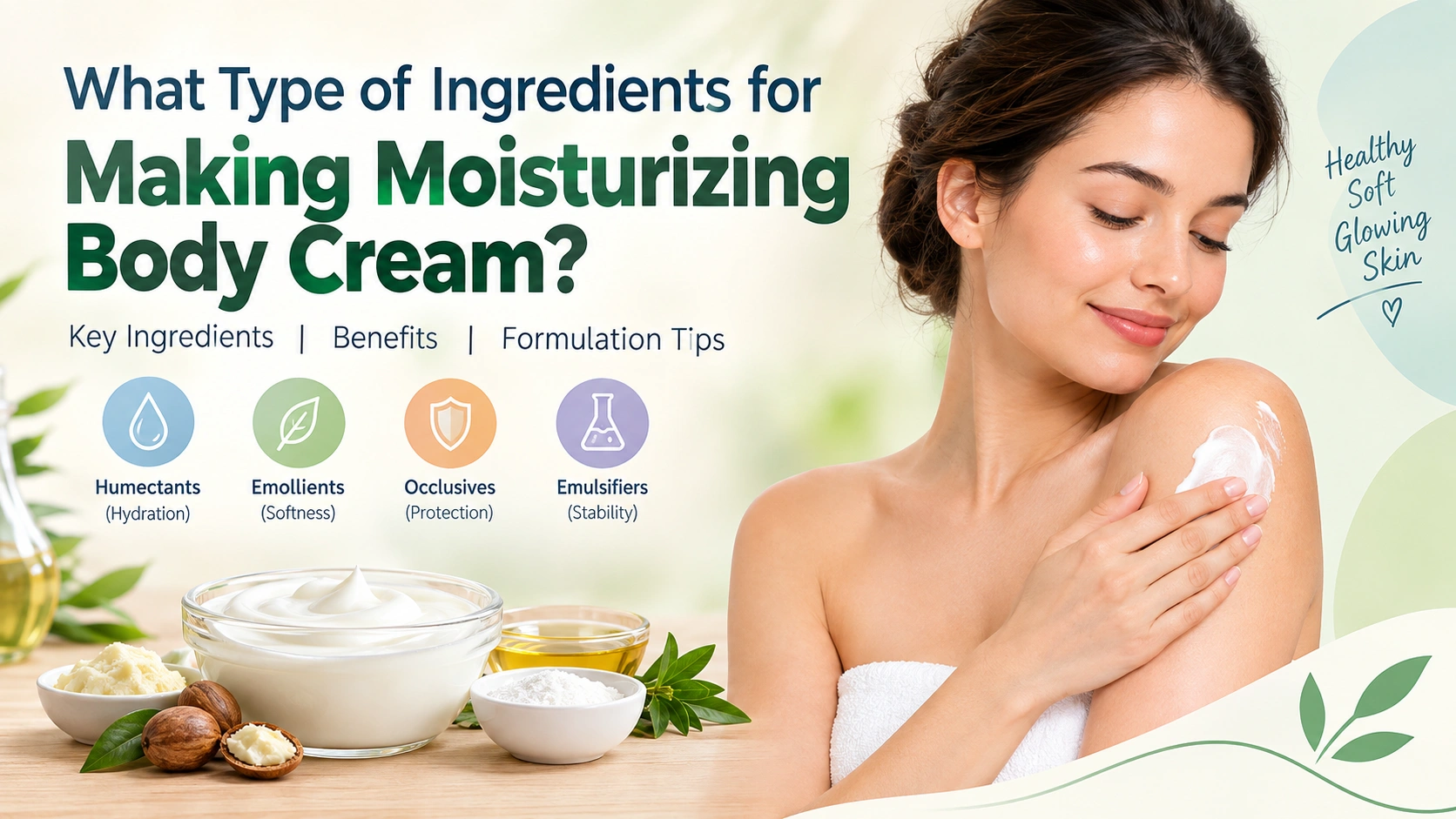
Humectants are responsible for attracting and holding water around the skin. Glycerin is one of the most widely used examples because it is versatile, effective, economical, and suitable for many formulations. Other humectants include propylene glycol, butylene glycol, sodium PCA, panthenol, and certain forms of hyaluronic acid.
Emollients provide softness and improve the sensory properties of a cream. They fill spaces between skin cells and create a smoother surface, helping the skin feel supple rather than rough. Common cosmetic emollients include plant oils, esters, triglycerides, squalane, fatty alcohols, and carefully selected synthetic skin-conditioning ingredients.
Occlusive ingredients work differently by forming a protective layer that helps reduce transepidermal water loss. Petrolatum is one of the best-known occlusive materials used in skincare. Products such as Vaseline Blueseal Baby Petroleum Jelly demonstrate how petrolatum-based formulations can provide a protective barrier, particularly when skin needs additional moisture-loss protection.
Essential Ingredients for Making Moisturizing Body Cream
The foundation of making moisturizing body cream is selecting ingredients according to the skin concern and desired product performance. A good formulation normally combines hydration, nourishment, protection, stability, and pleasant application characteristics. Simply increasing the amount of oil does not necessarily make a cream more moisturizing; balance between different ingredient categories is much more important.
Humectants for Water-Based Hydration
Humectants are essential when developing products intended to provide lasting hydration. They attract water and help maintain a hydrated feel on the skin. Glycerin remains one of the most popular choices because it performs reliably across numerous formulations. Combining glycerin with other compatible humectants can provide a more balanced sensory profile.
Hyaluronic acid and sodium PCA can also be considered when creating premium moisturizing products. These ingredients are particularly attractive for formulations positioned around intensive hydration. However, ingredient selection should always consider concentration, compatibility, formulation stability, product claims, and the intended consumer rather than relying solely on marketing popularity.
Emollients for Softness and Smoothness
Emollients are equally important because hydrated skin should also feel smooth and comfortable. Ingredients such as shea butter, cocoa butter, sunflower oil, sweet almond oil, jojoba oil, caprylic/capric triglyceride, and squalane can contribute different textures and skin-feel characteristics.
For commercial formulations, formulators often combine multiple emollients rather than relying on a single oil. One ingredient may provide richness while another improves spreadability, absorption, or after-feel. This approach allows the finished body cream to deliver nourishment without becoming excessively greasy or heavy.
Occlusives for Moisture Retention
Occlusives become particularly valuable when the product is intended for very dry, rough, or compromised-feeling skin. Petrolatum, mineral oil, waxes, and certain silicones can help reduce moisture loss from the skin surface. Their inclusion depends on the intended positioning, texture, target consumer, and regulatory requirements of the finished product.
A useful reference point is La Roche-Posay Lipikar Balm AP+ Body Cream, which is positioned as a rich body moisturizer for dry and sensitive skin. Commercial products of this type demonstrate how moisturizing systems can combine several functional approaches rather than depending on one ingredient alone.
Emulsifiers and Consistency Agents
An emulsifier is essential for many cream formulations because it helps oil and water remain uniformly dispersed. Without suitable emulsification, a cream can separate, become unstable, or develop an undesirable texture. Common emulsifying systems include glyceryl stearate-based systems, cetearyl alcohol combinations, emulsifying waxes, and other professionally designed emulsifiers.
Fatty alcohols such as cetyl alcohol, cetearyl alcohol, and stearyl alcohol can also improve consistency and stability. Despite the word “alcohol,” these materials are structurally different from drying alcohols such as ethanol. In creams, fatty alcohols are commonly used as thickening, stabilizing, and texture-enhancing ingredients.
What Are the Key Ingredients in Body Cream?
What are the key ingredients in body cream? The answer depends on the purpose of the formulation, but a professional cream generally needs ingredients covering hydration, emollience, occlusion, emulsification, preservation, and sensory performance. Additional actives can then be introduced depending on whether the product targets dryness, dullness, uneven appearance, sensitivity, or other cosmetic concerns.
A well-balanced formulation should also consider pH. The pH of the finished product can affect skin compatibility, preservative performance, ingredient stability, and overall product quality. Formulators therefore normally measure and adjust pH rather than assuming that every combination of ingredients will automatically produce a suitable final value.
Preservatives are another important consideration whenever water is present. Water-containing creams can provide an environment where microorganisms may grow if the formulation is not properly preserved. A suitable broad-spectrum preservation system should be selected according to the complete formulation, packaging, manufacturing process, and applicable cosmetic regulations.
Ingredients for Making Moisturizing Body Cream in India
The market for Ingredients for making moisturizing body cream in india includes a broad range of cosmetic raw materials, from basic emollients and humectants to specialty actives and sophisticated emulsifying systems. Manufacturers can select ingredients based on target price, performance, consumer expectations, formulation philosophy, and whether the product is positioned as mass-market, professional, natural, premium, or dermatological skincare.
Raw-material sourcing should also consider documentation and quality consistency. Cosmetic manufacturers should evaluate specifications, certificates of analysis, technical information, allergen information where relevant, recommended usage levels, and supplier reliability. Consistent raw materials are especially important for commercial manufacturing because variations can influence viscosity, appearance, fragrance, stability, and consumer experience.
Four Practical Ingredient Groups for a Basic Formula
For beginners, thinking about formulation in functional groups can make product development easier. Instead of immediately working with a long ingredient list, start by understanding the purpose of each component. A simple concept can then be developed into a more sophisticated formulation after stability, preservation, texture, and compatibility have been properly evaluated.
- Hydration: Water, glycerin, sodium PCA, panthenol, or other suitable humectants help increase and maintain water availability around the skin.
- Nourishment: Plant oils, shea butter, cocoa butter, squalane, and cosmetic esters contribute softness and improve the cream’s sensory character.
- Protection: Petrolatum, selected waxes, and other occlusive materials can help reduce moisture loss and support a protective skin feel.
- Structure and stability: Emulsifiers, fatty alcohols, thickeners, preservatives, chelating agents, and pH adjusters help create a stable finished formulation.
Ingredients for Making Moisturizing Body Cream for Dry Skin
When developing Ingredients for making moisturizing body cream for dry skin, the formulation should generally prioritize hydration and moisture retention. Dry-feeling skin often benefits from a combination of humectants, emollients, and occlusive ingredients. A richer cream may therefore contain glycerin alongside nourishing oils, butters, fatty alcohols, and barrier-supportive ingredients.
The texture should remain comfortable enough for regular application. An excessively greasy formula may discourage consumers from using it consistently, even if it provides strong occlusion. For this reason, formulators frequently combine richer ingredients with lighter emollients that improve spreadability and reduce the heavy after-feel associated with highly occlusive formulations.
A product such as CeraVe Skin Renewing Night Cream provides a useful example of how modern moisturizers can combine moisturizing agents with skin-conditioning ingredients in a consumer-friendly texture. While a commercial product should not be copied, its ingredient philosophy illustrates the importance of combining hydration, conditioning, and sensory performance.
How to Make Body Cream with Natural Ingredients
How to make body cream with natural ingredients requires more consideration than simply replacing synthetic materials with plant-derived alternatives. Natural oils, butters, botanical extracts, waxes, and other ingredients can be incorporated into cosmetic formulations, but they still require appropriate emulsification, preservation, compatibility testing, and stability evaluation.
Shea butter, cocoa butter, sunflower oil, jojoba oil, sweet almond oil, aloe vera, and selected botanical extracts are commonly considered when developing naturally positioned skincare products. However, “natural” does not automatically mean safer, more effective, or suitable for every skin type. The quality, concentration, purity, and formulation context remain important.
A Simple Four-Ingredient Concept
A 4 ingredients lotion recipe can help beginners understand the basic concept of a moisturizer, but a commercial product usually requires considerably more formulation work. A conceptual combination might include water, a humectant, an emollient, and an emulsifying component. However, a water-based commercial lotion generally also requires preservation and proper testing.
For professional production, the formula should be developed with appropriate laboratory procedures rather than relying on a kitchen-style recipe. Microbiological testing, stability testing, packaging compatibility, viscosity evaluation, pH measurement, and preservative effectiveness are important steps before a water-containing product is released to consumers.
Ingredients for Making Moisturizing Body Cream for Oily Skin
When selecting Ingredients for making moisturizing body cream for oily skin, the main objective is usually hydration without creating an excessively heavy or greasy skin feel. Lightweight humectants, fast-spreading emollients, and appropriately selected esters can help produce a comfortable formulation. The goal is not to eliminate oils completely but to select them intelligently.
A lighter cream may use a higher proportion of water with ingredients such as glycerin, panthenol, lightweight esters, and non-heavy emollients. Silicone-based ingredients can also be considered where appropriate because they can improve slip and create a smooth sensory finish without necessarily producing the same oily sensation as heavier plant butters.
It is useful to distinguish body skincare from facial skincare when selecting a product concept. For example, La Roche-Posay Toleriane Double Repair Face Moisturizer is formulated for facial skincare and should not automatically be treated as a body-cream formulation template. Different body areas and consumer needs can require different textures and ingredient strategies.
Ingredients for Making Moisturizing Body Cream for Glowing Skin
For Ingredients for making moisturizing body cream for glowing skin, hydration and surface smoothness are usually central to the desired appearance. Well-hydrated skin can appear softer, smoother, and more supple. Formulators may also consider cosmetic ingredients associated with brightening or improving the appearance of uneven-looking skin, depending on the intended product claims.
Ingredients such as niacinamide, panthenol, selected botanical extracts, gentle exfoliating acids, and antioxidants may be considered in appropriate formulations. However, each active requires careful consideration of concentration, compatibility, pH, stability, and regulatory requirements. A “glowing skin” product should therefore be formulated around realistic cosmetic benefits rather than exaggerated promises.
Sun protection is also relevant when consumers are concerned about maintaining an even-looking complexion. La Roche-Posay Anthelios Sunscreen UVMUNE400 Oil Control Gel Cream SPF50+ illustrates a dedicated sunscreen approach. A regular body cream should not be marketed as sun protection unless it has been appropriately formulated, tested, and legally supported for the relevant SPF claim.
Ingredients for Making Moisturizing Body Cream for Fair Skin
The phrase Ingredients for making moisturizing body cream for fair skin is commonly searched by consumers looking for products that improve the appearance of uneven or dull skin. Professional cosmetic formulation should focus instead on hydration, radiance, and the appearance of an even skin tone, while avoiding unrealistic promises of changing a person’s natural skin colour.
For a cosmetic product positioned around an even-looking complexion, ingredients such as niacinamide, vitamin C derivatives, certain botanical ingredients, and gentle exfoliating agents may be evaluated. The correct choice depends on formulation stability and intended claims. Some actives can be sensitive to light, oxygen, pH, or temperature, making packaging and manufacturing important.
Products such as La Roche-Posay Anti-Marks Cream Gel demonstrate how targeted skincare can be positioned around the appearance of marks and uneven-looking skin. However, specialized facial products should not simply be transferred into a body-cream formula. Professional development requires considering the intended application area and complete formulation system.
Supporting Products and Their Role in a Skincare Routine
A moisturizing cream works best as part of a broader skincare routine rather than as an isolated product. Cleansing, moisturizing, and sun protection can all contribute to maintaining comfortable-looking skin. For example, La Roche-Posay Toleriane Hydrating Gentle Cleanser represents a gentle cleansing approach that can complement a moisturizing routine without making the cleanser itself the primary source of skin hydration.
Similarly, skincare products can be designed for different moments of the day. A lightweight moisturizer may be comfortable during daytime use, while a richer cream can be preferred at night. L’Oreal Paris Men Expert Hydra Energetic Face Cream demonstrates how moisturization can also be positioned around specific consumer preferences and lifestyle needs.
The distinction between face and body products is important when creating a commercial skincare range. Facial products often emphasize lighter textures, targeted actives, cosmetic elegance, and specific skin concerns. Body creams can accommodate richer textures and larger application areas. Understanding this distinction can help manufacturers develop more relevant product concepts.
Formulation Considerations Before Manufacturing
The quality of making moisturizing body cream depends not only on the ingredient list but also on processing conditions. Temperature, mixing speed, order of addition, cooling rate, homogenization, and ingredient compatibility can influence the final emulsion. Two formulas containing similar ingredients can perform differently when manufactured using different processing methods.
Packaging also deserves attention because it can influence product stability and consumer experience. Jars, tubes, pumps, and airless systems provide different levels of protection and usability. Ingredients that are sensitive to oxygen, light, or contamination may require packaging specifically selected to preserve the formulation throughout its intended shelf life.
Four Important Quality Checks
Before commercializing a moisturizer, manufacturers should evaluate more than its appearance immediately after production. A cream that looks excellent on the first day may change after weeks or months. Proper testing helps identify separation, odour changes, colour changes, viscosity shifts, microbial problems, or packaging interactions before the product reaches consumers.
- Stability testing: Evaluate appearance, colour, odour, viscosity, pH, and physical stability under appropriate storage conditions.
- Microbiological evaluation: Water-containing products should be assessed for microbial quality and appropriate preservation performance.
- Packaging compatibility: Confirm that the container does not negatively interact with the formula or compromise product quality.
- Consumer sensory evaluation: Assess spreadability, absorption, greasiness, residue, softness, fragrance, and overall application experience.
Choosing Ingredients Based on the Target Consumer
Successful making moisturizing body cream requires a clear understanding of who will use the product. A premium body cream may prioritize luxurious emollients and elegant textures, while a budget-friendly lotion may focus on reliable hydration at an accessible cost. Products for sensitive-feeling skin may emphasize simpler formulas and carefully selected ingredients.
Marketing claims should also influence formulation decisions from the beginning. Terms such as moisturizing, nourishing, lightweight, radiance-enhancing, soothing, or barrier-supportive can imply different formulation expectations. Claims should be supported by the product’s actual formulation and appropriate evidence, particularly when developing products for commercial sale.
Ingredient sourcing is another major consideration for manufacturers in India. Reliable suppliers can provide technical documentation, batch consistency, recommended handling information, and appropriate quality support. This becomes especially important when developing a product at scale because inconsistent raw materials can lead to differences between manufacturing batches.
Building a Professional Moisturizing Body Cream
The best approach to making moisturizing body cream is to build the formula around a clear performance objective. Start by deciding whether the product should be lightweight, rich, nourishing, natural-positioned, sensitive-skin focused, or designed for a particular cosmetic concern. This decision provides direction for selecting humectants, emollients, occlusives, emulsifiers, and additional actives.
A professional formula should then be tested systematically. Adjustments to oil concentration, humectant levels, emulsifier systems, thickening agents, or active ingredients can significantly change viscosity and sensory performance. Rather than adding ingredients simply because they are popular, each component should contribute a defined benefit to the finished product.
The final objective is a moisturizer that performs consistently, feels pleasant, remains stable, and meets the expectations created by its packaging and marketing. Whether the product is intended for personal use, private-label manufacturing, or a larger cosmetic brand, thoughtful formulation is more valuable than simply using a long ingredient list.
Final Thoughts
Ultimately, making moisturizing body cream is a balance between science, formulation technique, ingredient selection, and consumer expectations. Water and humectants provide hydration, emollients improve softness, occlusives help reduce moisture loss, while emulsifiers, thickeners, preservatives, and pH adjusters contribute to stability and usability. The right combination depends on the product’s purpose.
There is no single ingredient that makes every moisturizer effective. Dry skin may benefit from richer emollients and occlusives, while oily skin may respond better to lightweight hydration. Natural-positioned products require careful preservation and stability considerations, while targeted products require thoughtful active selection and responsible cosmetic claims.
Whether you are a beginner exploring cosmetic formulation or a manufacturer developing a commercial skincare product, understanding the function of every ingredient is the strongest starting point. With the right balance of hydration, nourishment, protection, texture, stability, and testing, it becomes possible to develop a professional body moisturizer that provides a consistent and enjoyable skincare experience.